
Protection of the room
Drop cloths over the hearth and floor, a dust barrier or sealed firebox opening, and a HEPA vacuum running during brushing so soot stays out of the house.
San Antonio Chimney Sweeps connects San Antonio-area homeowners with independent local chimney sweep, inspection and repair companies for free, no-obligation quotes. Tell us about your fireplace, and local sweeps that clean masonry chimneys, prefab fireboxes, wood stoves and inserts send their prices.
Get a Free Quote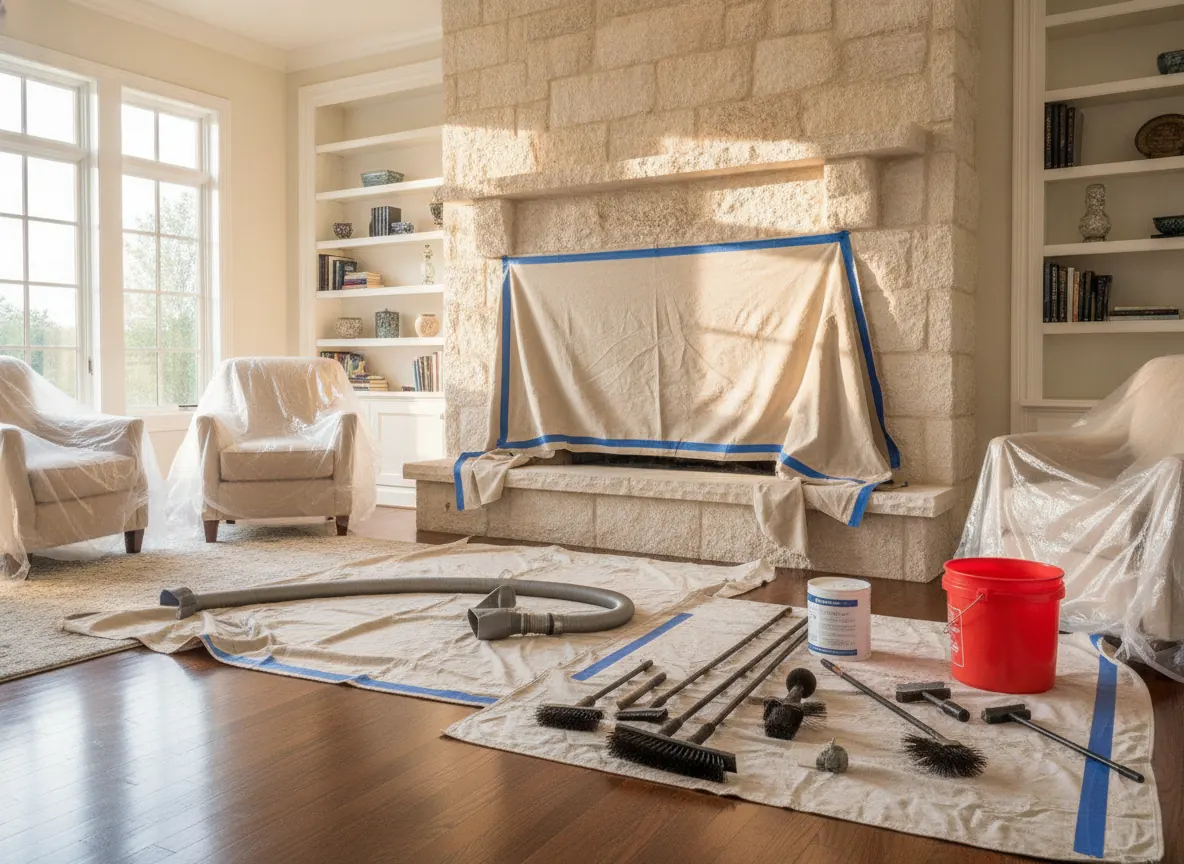
Most chimneys in Bexar County fall into one of two groups. The first is the site-built masonry chimney: brick or limestone with a clay-tile flue, a throat damper and a poured crown, common in the 1920s–1970s neighborhoods inside Loop 410. Alamo Heights has a median year built of 1950, Terrell Hills 1957 and the Monte Vista ZIP code 1949 (ACS 2024 5-year), so these are the areas where sweeps see older masonry chimneys and decades of occasional wood fires.
The second is the prefab or factory-built fireplace, also called a zero-clearance unit: a metal firebox and a metal flue pipe inside a framed, sided chase, finished with a metal chase cover and a small cap. These went into most 1980s–2000s subdivisions on the north and west sides. Bexar County as a whole has a median year built of 1990, with 37.2% of housing units built between 1970 and 1999 (ACS 2024 5-year), which is why a sweep company usually asks which type you have before quoting. Chase cover and cap replacement is covered on its own page.
Scopes vary by company; this is the work a standard quote normally covers. Ask for anything missing to be written in.
Drop cloths over the hearth and floor, a dust barrier or sealed firebox opening, and a HEPA vacuum running during brushing so soot stays out of the house.
Ash and debris cleared from the firebox, the damper worked and brushed, and the smoke chamber above it scrubbed.
Rotary or hand rods and brushes sized to the flue, run from the top or the bottom, until the liner or pipe is free of loose soot and creosote.
Companies that follow NFPA 211 include a Level 1 look at the accessible parts of the chimney during the sweep: firebox, damper, flue as visible, cap and crown from the roof. A camera scan is a Level 2 chimney inspection, typically about $50–$75 more when added to a sweep.
Inserts often have to be pulled to reach the flue behind them, and pellet stoves have their own exhaust runs. These take longer than an open fireplace and are usually quoted as a separate line.
Leaf litter, ball moss, old nesting material and the occasional animal are removed before sweeping, with one exception: an active chimney swift nest is protected and is left until the birds leave (see below).
The standard in this trade is NFPA 211. The Chimney Safety Institute of America summarizes it this way: the standard "calls for inspection at least once a year for soundness, freedom from deposits, and correct clearances. Cleaning, maintenance, and repairs shall be done if necessary," and the annual check applies to unused chimneys too, because "animals may build nests in the flue or there may be other types of deterioration." In plain terms: an inspection every year, and a sweep whenever that inspection finds deposits that call for one.
That matters in San Antonio because the burning season is short. The airport's 1991–2020 normals show 1,438.4 heating degree days a year, 72% of them in December through February, and 14.0 nights at or below 32 °F. The median first freeze is November 28. Most local fireplaces are lit a few dozen evenings a winter and then sit idle from March through November, through 17.7 days at or above 100 °F and a wet May (4.40 inches, the wettest month). An idle flue collects rain through an uncapped opening, spring live-oak leaf drop, pecan debris and, from mid-March, nesting chimney swifts. So the local problem is rarely heavy creosote from constant burning; it is what accumulates while nothing burns, found and cleared before the first cold front rather than after.
Timing tip: October and November are the busiest months for sweeps here. Chimney swifts leave Texas in the fall and return from mid-March, so a flue that hosted birds is swept and capped generally late October to February (Texas-wide guidance). Read more in our chimney swift guide.
Typical national ranges from Fixr (2025) and Angi via Bob Vila (2023) — estimates, not quotes.
| Item | Typical range |
|---|---|
| Chimney sweep / cleaning | $130–$380 (average about $255); Fixr's wider band $100–$500 |
| Gas fireplace flue | $85–$250 |
| Pellet stove | $175–$350 |
| Wood stove | $200–$500 |
| Camera inspection added to a sweep | About $50–$75 more |
Local companies advertise starting prices from roughly $99 to $195, which usually exclude prefab units, extra flues and repairs. For a fuller breakdown, see the San Antonio chimney sweep cost guide.
Texas has no chimney-sweep license; TDLR's list of regulated programs includes none for chimneys, hearths, masonry, roofing or general contracting. The credentials that exist are private. Before booking, ask a company for:
Sweeping needs no City of San Antonio permit we could find. See the quote process for how requests are matched, or browse areas such as Alamo Heights and Boerne.
NFPA 211, as summarized by CSIA, calls for an inspection at least once a year and cleaning "if necessary." With a burning season concentrated in December through February and only about 14 freezing nights a year, many local fireplaces need a sweep less often than yearly, but the annual look still catches moisture damage, debris and nests in a flue that sat idle since March.
A careful company covers the hearth and floor with drop cloths, seals the firebox opening or runs a HEPA vacuum throughout, and bags the soot before it leaves the room. Ask how the crew controls dust and whether cleanup is included in the quote. Most homeowners report no visible soot afterward, though a faint smoky smell for a few hours is normal.
Gas burns far cleaner than wood, so soot is rarely the issue, but the flue still needs the annual check for blockages, nests and corrosion, and a vented log set still sends combustion gases up the chimney. Companies typically quote gas flues at $85–$250 (national estimates). See the gas fireplace service page for burner and pilot work.
The goal is the same, but the tools differ. A prefab unit has a metal flue pipe that takes softer, correctly sized brushes, refractory panels that crack if handled roughly, and a metal chase cover that often rusts. Many companies price prefab sweeps separately and check the chase cover and cap while on the roof, so mention the type when requesting quotes.
No. Texas has no chimney-sweep license; TDLR's list of regulated industries includes nothing for chimneys, hearths or masonry. CSIA and NFI are private certifications, valid for three years in CSIA's case, which you can verify online. Ask for those, proof of insurance and a written scope. This is general information, not legal advice. Our licensing explainer has more detail.
Free, no-pressure quotes across San Antonio, Alamo Heights, Boerne, New Braunfels, Schertz and Bexar County.